









Quick Summary
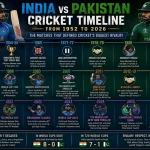
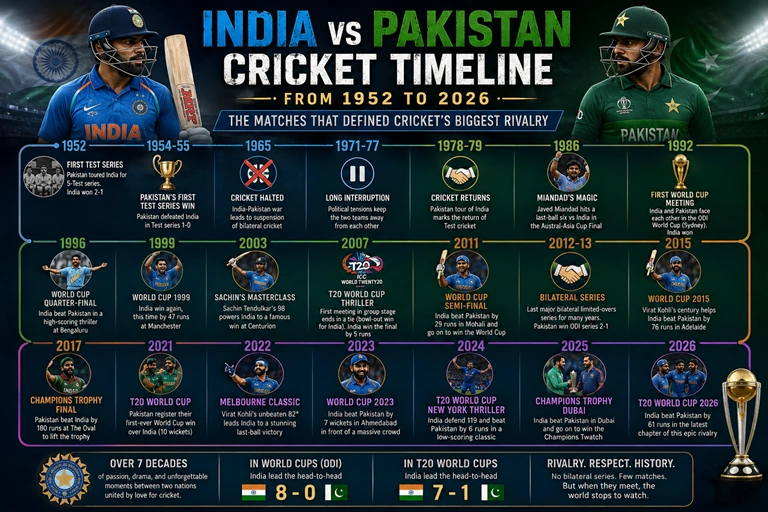
- 1952: India and Pakistan met for the first time in Test cricket, beginning a rivalry that has lasted for more than seven decades.
- 1965–1977: Political tensions and wars interrupted bilateral cricket between the two countries.
- 1978–79: Pakistan toured India, marking the revival of Test cricket between the neighbours.
- 1992: India and Pakistan met for the first time in the Cricket World Cup.
- 2003: Sachin Tendulkar’s famous World Cup innings became one of the rivalry’s most remembered moments.
- 2007: The inaugural T20 World Cup produced two India-Pakistan thrillers, including the final.
- 2011: India beat Pakistan in the World Cup semi-final in Mohali.
- 2017: Pakistan defeated India in the Champions Trophy final at The Oval.
- 2022: Virat Kohli’s unbeaten 82 helped India produce one of the most dramatic T20 World Cup wins in Melbourne.
- 2024: India defeated Pakistan by six runs in a low-scoring T20 World Cup thriller in New York.
- 2025: India beat Pakistan in the Champions Trophy in Dubai and later went on to win the tournament.
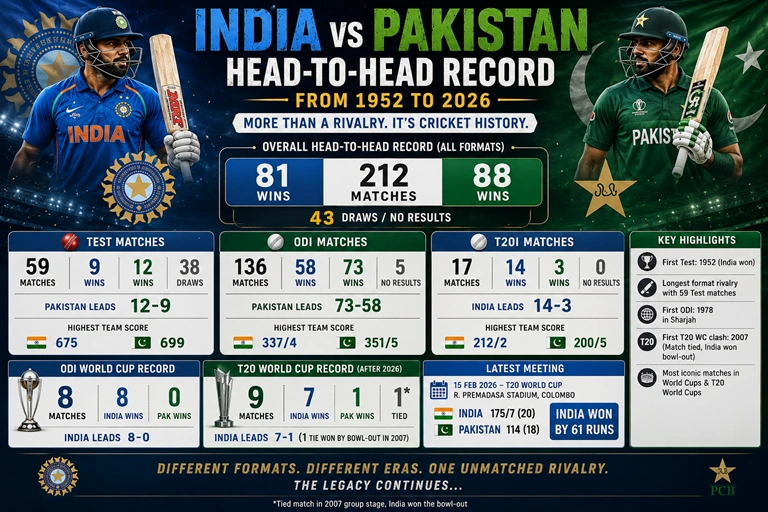
- 2026: India defeated Pakistan by 61 runs in the T20 World Cup, adding another chapter to the rivalry.
Why the India vs Pakistan Cricket Rivalry Is So Different
There are cricket rivalries built around trophies, others around long Test series and some around decades of competitive balance. India vs Pakistan is different.
When these two teams walk onto a cricket field, the match rarely feels like an ordinary fixture.
The rivalry began in 1952, only a few years after Partition, when Pakistan made its first Test tour of India. The opening series was competitive but friendly enough by the standards of what followed: India won the five-Test series 2-1. The ICC describes that 1952 tour as the beginning of one of cricket’s most passionate rivalries.
What makes the history fascinating is how often the rivalry has changed shape.
It began in Test cricket. It became increasingly associated with high-pressure ODIs. Then came World Cups, the Asia Cup and eventually T20 cricket, where a single over can completely change the story.
There have also been long periods when the teams simply could not play each other bilaterally. Political relations repeatedly affected cricket, meaning that when India and Pakistan eventually met again, the occasion carried even more weight.
That combination of history, scarcity and sporting pressure is what gives the India vs Pakistan cricket timeline its unique character.
India vs Pakistan Cricket Timeline: 1952 to 1977
1952: The rivalry begins
Pakistan became a Test-playing nation in 1952. The ICC records Pakistan’s admission to the organisation on July 28, 1952, followed by its first Test match in October that year.
Later that year, Pakistan toured India for its first Test series against its newly established cricketing neighbour.
India won the series 2-1, with the five-Test contest establishing the first competitive chapter between the two teams.
At that stage, nobody could have known what the rivalry would eventually become.
The early contests were dominated by Test cricket. Matches could stretch across five days, and patience mattered as much as attacking strokeplay. A rivalry that is now associated with packed stadiums and global television audiences was initially built on long, tactical contests.
1954–1961: Competitive Test cricket
The following decade produced several Test meetings, with both teams learning how to compete against each other.
Pakistan recorded its first Test series victory over India in 1954–55, while subsequent encounters produced a mixture of victories and draws.
The cricket itself was gradually developing alongside both nations’ international identities. Players such as Fazal Mahmood became important figures for Pakistan, while India’s early Test teams were built around technically skilled batters and disciplined bowlers.
The rivalry was already becoming more competitive, but it had not yet acquired the intensity associated with later generations.
1965–1977: A long interruption
The 1965 India-Pakistan war brought bilateral cricket to a halt. The conflict of 1971 caused another major interruption.
According to the ICC’s historical account, the cricketing stand-off lasted for about 18 years before the teams met again in the late 1970s.
This interruption is one of the most important parts of the timeline because it explains why India-Pakistan cricket has so often been shaped by scarcity.
When two teams play every year, a disappointing match eventually becomes old news.
When meetings disappear for years, every return feels enormous.
1978–1989: Cricket Returns and the Rivalry Intensifies
1978–79: The first major revival
Pakistan hosted India in 1978–79, bringing international cricket between the two nations back after the long break.
The return was not entirely smooth. The ICC notes that concerns over home umpiring surfaced during the series, contributing to discussions about neutral officials.
That eventually became significant beyond this particular rivalry.
The India-Pakistan contests helped expose the pressures that could surround international matches when the stakes were enormous and the teams had long gaps between meetings.
The 1980s: Kapil Dev, Javed Miandad and a new generation
The 1980s gave the rivalry a new personality.
India had Kapil Dev and a growing collection of world-class players. Pakistan had stars such as Javed Miandad, Imran Khan and Wasim Akram.
ODI cricket was also becoming increasingly important.
Instead of waiting five days for a result, fans could watch a match unfold in a single day. That suited India-Pakistan cricket perfectly. A close chase, a late wicket or a controversial moment could immediately become part of cricket folklore.
The teams also became regular opponents in tournaments and bilateral encounters.
1986: The Sharjah era
Sharjah became one of the most important neutral venues in India-Pakistan cricket.
With political and logistical factors making home-and-away bilateral cricket difficult at various points, matches in the United Arab Emirates provided a neutral stage.
And Sharjah produced some of the rivalry’s most dramatic moments.
The 1986 Austral-Asia Cup final is the obvious example. Pakistan needed four runs from the final ball against India. Javed Miandad hit Chetan Sharma for a six, producing one of the most famous last-ball finishes in ODI history.
That moment changed the emotional vocabulary of the rivalry.
A match that appeared to be India’s to win suddenly belonged to Pakistan.
For Indian fans, it was heartbreak. For Pakistan, it became one of the defining victories of the Miandad era.
1992–1999: World Cup Cricket Changes Everything
1992: India and Pakistan meet at the World Cup
The Cricket World Cup added another layer to the rivalry in 1992.
India and Pakistan met at the World Cup for the first time in Sydney.
Pakistan entered the tournament as eventual champions, but India won their group-stage encounter.
That victory started one of the most extraordinary patterns in World Cup cricket: India’s dominance over Pakistan in their World Cup meetings.
The result itself was significant, but the larger impact was psychological. The World Cup suddenly gave the rivalry a global stage.
1996: The Bengaluru quarter-final
Four years later, India and Pakistan met again in the World Cup, this time in a quarter-final at Bengaluru.
The match featured a memorable batting performance from Ajay Jadeja and a tense contest against Pakistan’s powerful batting lineup.
India eventually won and advanced to the semi-final.
For the rivalry, the important point was simple: World Cup meetings were becoming knockout events rather than just group-stage fixtures.
1999: Another World Cup victory for India
The teams met again during the 1999 World Cup in Manchester.
India won the match by 47 runs.
Pakistan eventually reached the final of that tournament, but the India defeat remained another reminder that World Cup encounters had developed their own strange pattern.
By the end of the 1990s, the rivalry had moved far beyond bilateral Test cricket.
It was now one of the defining fixtures in global limited-overs cricket.
2003–2011: Tendulkar, World Cups and the Rise of Television Cricket
2003: Sachin Tendulkar’s famous World Cup innings
If one match from the 2003 World Cup best represents the era, it is India’s clash with Pakistan at Centurion.
Pakistan posted a challenging total after Saeed Anwar’s century.
India’s response was led by Sachin Tendulkar.
His 98 from 75 balls became one of the most replayed innings in World Cup history. The upper-cut six off Shoaib Akhtar became an iconic image of the rivalry.
India chased down Pakistan’s target with six wickets in hand.
For a generation of Indian cricket fans, this became the India-Pakistan World Cup match.
2004–2006: Bilateral cricket resumes
The early 2000s brought another important change: regular bilateral cricket returned.
India toured Pakistan in 2004, and Pakistan toured India in 2005–06.
These series mattered because they restored something that tournament cricket could not provide: extended contests across Tests and ODIs.
A bilateral series allowed players to recover from one defeat, adjust tactics and build narratives across multiple matches.
The cricket was also increasingly shaped by stars such as Virender Sehwag, Rahul Dravid, Sachin Tendulkar, Inzamam-ul-Haq, Shoaib Akhtar and Mohammad Yousuf.
2007: The T20 revolution
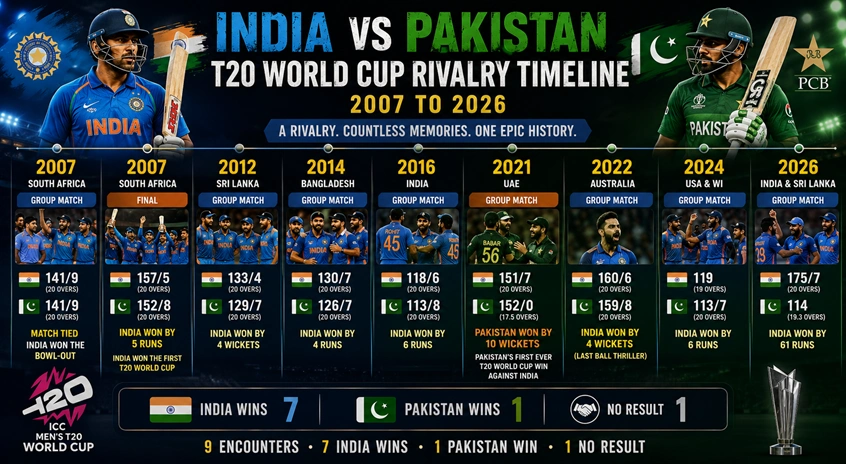
The inaugural ICC Men’s T20 World Cup in 2007 transformed the rivalry again.
India and Pakistan met twice.
Their group-stage match ended in a tie and was decided by a bowl-out, one of the most unusual finishes in the history of major international cricket.
India won the bowl-out.
Then came the final.
The two teams met again in Johannesburg, with India defending a modest total. Pakistan came close, but India won by five runs after Misbah-ul-Haq was caught attempting an audacious scoop.
India became the first T20 World Cup champions.
The ICC notes that the inaugural tournament featured both the bowl-out between India and Pakistan and the dramatic final, with India ultimately claiming the title.
Two matches. Two wildly different finishes. One rivalry that suddenly had a new format to dominate.
2011–2019: World Cup Pressure, Champions Trophy Heartbreak and a New Era
2011: Mohali World Cup semi-final
India and Pakistan met in the 2011 World Cup semi-final at Mohali.
This was arguably the biggest India-Pakistan match played on Indian soil up to that point.
Sachin Tendulkar was at the centre of India’s innings, surviving several close chances before making 85.
Pakistan’s chase remained competitive but India eventually won by 29 runs.
The victory sent India into the World Cup final, where MS Dhoni’s team defeated Sri Lanka in Mumbai to lift the trophy.
For India, the Pakistan semi-final became an important part of the championship story.
2012–13: Pakistan tours India
The 2012–13 limited-overs series was another notable chapter because Pakistan toured India for bilateral matches.
The series included two T20Is and three ODIs.
Pakistan won the ODI series 2-1, while India won the T20I series 1-0 after the opening match was tied.
It would become one of the last bilateral cricket encounters between the senior men’s teams for many years.
2015: Another World Cup meeting
At the 2015 World Cup in Adelaide, India defeated Pakistan by 76 runs.
Virat Kohli scored a century, while India’s bowling attack defended a substantial total.
The victory extended India’s unbeaten World Cup record against Pakistan.
By this point, the World Cup fixture had become a tournament within the tournament.
2017: Pakistan’s Champions Trophy revenge
Then came one of the biggest reversals in the timeline.
India and Pakistan met in the Champions Trophy final at The Oval in London.
Pakistan produced an extraordinary performance.
Fakhar Zaman scored 114, Pakistan reached 338/4, and Mohammad Amir removed Rohit Sharma and Virat Kohli early in India’s reply. India were eventually dismissed for 158.
Pakistan won by 180 runs and lifted the Champions Trophy.
The result was significant because Pakistan had finally defeated India in a major ICC final.
It also demonstrated just how quickly the rivalry could turn.
2021–2026: The Modern T20 Era
2021: Pakistan finally beats India in a World Cup
For years, Pakistan had carried the unwanted statistic of never defeating India at the men’s 50-over World Cup or T20 World Cup.
That changed in Dubai in 2021.
Pakistan won by 10 wickets.
Babar Azam and Mohammad Rizwan chased India’s target without losing a wicket.
It was Pakistan’s first World Cup victory over India.
The result was more than a win. It ended one of the most talked-about streaks in international cricket.
2022: Virat Kohli’s Melbourne masterpiece
The following year, India and Pakistan met at the Melbourne Cricket Ground during the 2022 T20 World Cup.
Pakistan made 159/8.
India then fell to 31/4.
For much of the chase, Pakistan looked to be in control.
Then Virat Kohli produced one of the defining innings of his career.
He finished unbeaten on 82 from 53 balls.
India needed 28 from the final eight deliveries at one stage, and Kohli’s extraordinary finishing changed the match. India eventually won from the final ball.
The ICC later described the Melbourne victory as one of the defining moments in the rivalry, highlighting Kohli’s 82 not out and the dramatic finish.
2023: Asia Cup and World Cup
India and Pakistan met in the 2023 Asia Cup, although their group-stage match was abandoned because of rain.
They met again in the Super Four stage, where India produced a commanding victory.
Later that year, the teams faced each other at the 2023 Cricket World Cup in Ahmedabad.
India won by seven wickets.
The result continued India’s remarkable World Cup record against Pakistan and added another huge crowd to the rivalry’s growing modern history.
2024: New York thriller
The 2024 T20 World Cup produced one of the most unusual India-Pakistan matches in recent memory.
Played at the Nassau County International Cricket Stadium in New York, the match was a low-scoring contest on a difficult pitch.
India managed only 119.
Pakistan appeared to be in control during the chase, but India’s bowlers fought back dramatically.
India won by six runs.
The ICC noted that the 2024 match was part of a long sequence of T20 World Cup encounters between the teams, with India entering the game having won six of their previous seven meetings in the tournament.
2025: Champions Trophy in Dubai
The rivalry continued at the 2025 Champions Trophy.
Because of the tournament’s arrangements, India’s matches were played in Dubai rather than Pakistan. The ICC had confirmed that India-Pakistan matches at ICC events during the 2024–27 rights cycle would be played at a neutral venue.
India and Pakistan met in Dubai on February 23, 2025.
India won the match comfortably.
The significance extended beyond the result. India went on to remain unbeaten throughout the tournament and defeated New Zealand in the final to win the Champions Trophy.
2026: Another T20 World Cup chapter
The latest major chapter arrived at the 2026 T20 World Cup.
India faced Pakistan on February 15, 2026.
India scored 175/7, with Ishan Kishan making 77 from 43 balls. Pakistan struggled during the chase as India’s bowlers maintained pressure throughout the innings.
India won by 61 runs.
Hardik Pandya, Jasprit Bumrah, Axar Patel and Varun Chakaravarthy all played important roles with the ball, while India’s batting gave the bowlers a substantial target to defend.
That result means the rivalry has continued to produce major tournament meetings even as bilateral cricket between the two sides remains limited.
And that is perhaps the most revealing feature of the modern timeline: when India and Pakistan meet, it is usually at an ICC event, which makes the pressure even greater.
What Are the Most Memorable India vs Pakistan Cricket Matches?
A shortlist will always be subjective, but several matches stand above the rest.
1. 1986 Austral-Asia Cup Final
Javed Miandad’s last-ball six against India remains one of cricket’s most famous finishes.
2. 1992 World Cup
India defeated Pakistan in their first World Cup meeting, beginning an extraordinary World Cup rivalry.
3. 2003 World Cup
Sachin Tendulkar’s 98 helped India chase Pakistan’s total at Centurion.
4. 2007 T20 World Cup Final
India won the inaugural T20 World Cup after a dramatic final against Pakistan.
5. 2011 World Cup Semi-Final
India beat Pakistan in Mohali before eventually winning the World Cup.
6. 2017 Champions Trophy Final
Pakistan responded emphatically, beating India by 180 runs at The Oval.
7. 2021 T20 World Cup
Pakistan finally defeated India in a World Cup, winning by 10 wickets.
8. 2022 T20 World Cup
Virat Kohli’s 82 not out powered India to a remarkable last-ball victory in Melbourne.
9. 2024 T20 World Cup
India defended only 119 in New York to win by six runs.
10. 2026 T20 World Cup
India defeated Pakistan by 61 runs, adding another modern chapter to the rivalry.
Why Don’t India and Pakistan Play Regular Bilateral Cricket?
This is one of the most common questions surrounding the rivalry.
The short answer is that political relations have repeatedly affected cricketing ties.
Unlike many other international cricket rivalries, India and Pakistan do not currently play a regular bilateral Test or limited-overs series schedule against one another.
That makes ICC tournaments and major multinational competitions especially important.
The result is a strange paradox.
Fans may have fewer opportunities to watch the teams play, but when the fixture appears on the calendar, interest is enormous.
The scarcity itself has become part of the rivalry.
The 2025 Champions Trophy demonstrated this clearly. The ICC arranged India’s matches in Dubai, while Pakistan hosted the wider tournament, reflecting the neutral-venue arrangement for India-Pakistan matches at ICC events in the relevant cycle.
India vs Pakistan Cricket Timeline: The Big Picture
| Year | Competition/Context | Major Moment |
|---|---|---|
| 1952 | Test series | First India-Pakistan Test series |
| 1954–55 | Test cricket | Pakistan wins its first Test series against India |
| 1965 | Bilateral cricket | War interrupts cricketing ties |
| 1971 | Bilateral cricket | Another major interruption |
| 1978–79 | Test series | Cricket resumes between the teams |
| 1986 | Austral-Asia Cup | Miandad hits famous last-ball six |
| 1992 | World Cup | First World Cup meeting; India wins |
| 1996 | World Cup | India wins quarter-final |
| 1999 | World Cup | India wins at Manchester |
| 2003 | World Cup | Tendulkar’s 98 becomes iconic |
| 2007 | T20 World Cup | India wins bowl-out and final |
| 2011 | World Cup | India wins semi-final |
| 2012–13 | Limited-overs series | One of the last bilateral series |
| 2015 | World Cup | India wins by 76 runs |
| 2017 | Champions Trophy | Pakistan wins final by 180 runs |
| 2021 | T20 World Cup | Pakistan wins World Cup meeting for first time |
| 2022 | T20 World Cup | Kohli’s 82* leads India to victory |
| 2023 | World Cup | India wins in Ahmedabad |
| 2024 | T20 World Cup | India wins by six runs in New York |
| 2025 | Champions Trophy | India beats Pakistan in Dubai |
| 2026 | T20 World Cup | India wins by 61 runs |
What Makes India vs Pakistan Cricket So Unpredictable?
Statistics can explain part of this rivalry, but they cannot fully explain the emotion around it.
One reason is the quality of individual players.
Over the decades, the rivalry has featured Sachin Tendulkar, Wasim Akram, Waqar Younis, Javed Miandad, Imran Khan, Kapil Dev, Rahul Dravid, Shoaib Akhtar, Virender Sehwag, MS Dhoni, Virat Kohli, Babar Azam, Rohit Sharma and many others.
Another reason is the pressure.
A player can perform brilliantly against almost every opponent but still be remembered most vividly for what happened against India or Pakistan.
Then there is the scarcity factor.
Because bilateral meetings are limited, a World Cup or Champions Trophy encounter can carry the emotional weight of an entire series.
That is why a match such as the 2022 Melbourne thriller becomes more than a scorecard. It becomes a shared cricket memory.
Frequently Asked Questions
When did India and Pakistan first play cricket against each other?
India and Pakistan first played a Test series in 1952. Pakistan toured India for its first Test series against its neighbour, and India won the five-match series 2-1.
When did India and Pakistan first meet in a World Cup?
India and Pakistan first met in the Cricket World Cup in 1992 in Sydney. India won the encounter, beginning a notable sequence of Indian victories over Pakistan in men’s ODI World Cup meetings.
What was the most famous India vs Pakistan T20 match?
The 2022 T20 World Cup match in Melbourne is widely regarded as one of the most memorable. Virat Kohli scored an unbeaten 82 from 53 balls as India completed a dramatic last-ball victory.
Who won India vs Pakistan in the 2026 T20 World Cup?
India defeated Pakistan by 61 runs in the 2026 T20 World Cup. India scored 175/7 before restricting Pakistan’s chase, with several Indian bowlers contributing wickets.
Conclusion
The India-Pakistan cricket rivalry cannot be reduced to a single statistic, World Cup record or famous player.
It began with a five-Test series in 1952, survived long periods without bilateral cricket, moved from Test cricket to ODIs and then embraced the explosive T20 era.
Miandad’s last-ball six, Tendulkar’s 2003 masterclass, India’s 2011 semi-final win, Pakistan’s 2017 Champions Trophy triumph, Kohli’s Melbourne heroics and India’s 2026 victory are all pieces of the same story.
The next chapter will inevitably bring another headline, another pressure-filled chase and another player who suddenly becomes part of cricket folklore.
That is the enduring appeal of India vs Pakistan: you may know the history, but you never quite know what the next match will give you.