



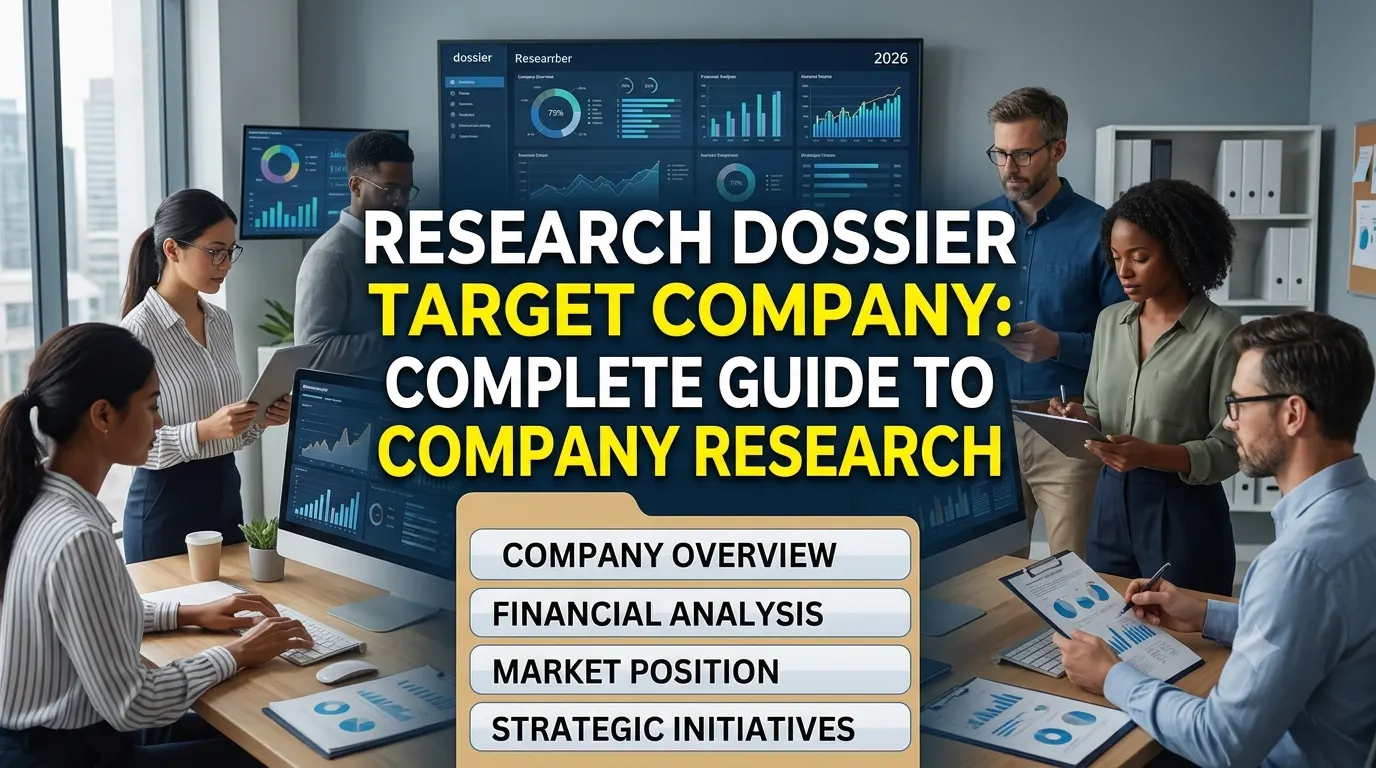











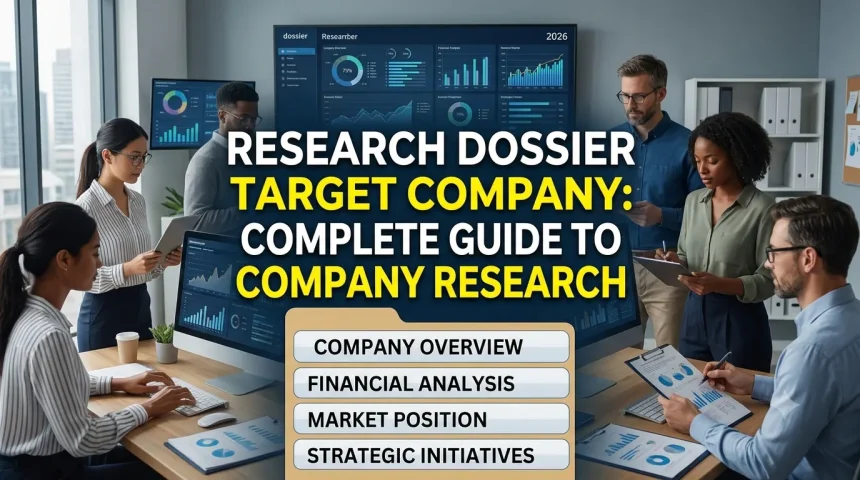
A research dossier for a target company is a structured report that collects, verifies, and analyzes important information about a business. It can cover the company’s ownership, leadership, business model, finances, competitors, reputation, legal exposure, risks, and recent developments. The goal is not to collect the largest possible amount of information, but to create a reliable evidence base for a specific business question.
In 2026, company research is becoming increasingly AI-assisted, but verification remains critical. Modern research tools can help discover filings, competitors, business information, and relevant documents faster, while researchers still need to check dates, sources, definitions, and context before treating a finding as reliable.
What Is a Research Dossier for a Target Company?
A research dossier target company report is essentially a detailed business intelligence document focused on one organization.
The term “target company” simply means the business being investigated. It could be:
- A potential investment
- A competitor
- A prospective client
- A supplier
- A business partner
- A potential acquisition target
- A company you are considering working for
- A business being studied for academic or market research
Unlike a basic company profile, a dossier connects facts with evidence and analysis.
For example, instead of simply writing that a company has thousands of employees, a good dossier records where the employee figure came from, when it was reported, whether it covers the entire group, and whether the number is current.
That distinction becomes increasingly important as company information changes quickly.
Why Is a Target Company Research Dossier Important?
A company website usually presents information from the company’s own perspective. A research dossier takes a wider view.
A useful dossier can help answer questions such as:
- Who actually owns the company?
- How does the business make money?
- Who are its major customers?
- How financially stable is it?
- Who are its main competitors?
- What risks could affect the business?
- What has changed recently?
- Which claims can be independently verified?
- What important information is still unknown?
The result is a more balanced research document rather than a collection of promotional statements.
Recent 2026 research guides are also emphasizing the importance of separating verified evidence from estimates, company claims, and unresolved questions.
What Should a Research Dossier for a Target Company Include?
A comprehensive dossier normally contains the following sections.
1. Company Identification
Start with the company’s basic identity.
Record:
- Legal company name
- Trading name
- Official website
- Headquarters
- Countries or regions served
- Industry
- Founding year
- Corporate structure
- Parent company and subsidiaries
- Public or private status
- Stock ticker, if applicable
This is the first verification step because similarly named companies can easily be confused.
2. Company History and Major Events
Build a short timeline covering significant events.
Look for:
- Founding
- Major expansions
- Acquisitions
- Mergers
- Product launches
- Leadership changes
- Market exits
- Funding rounds
- Restructuring
- Major partnerships
Don’t turn the history section into a long biography. Include events that explain the company’s present position.
3. Business Model
One of the most important questions is simple:
How does the company make money?
Research:
- Main products or services
- Revenue streams
- Pricing model
- Customer types
- Distribution channels
- Subscription or recurring revenue
- Advertising revenue
- Licensing
- Marketplace fees
- Geographic sources of revenue
A company may appear successful because of its size, but its underlying revenue model can reveal dependencies that aren’t obvious from its homepage.
4. Financial Performance
Financial information should be presented with its reporting period.
Depending on the company, examine:
- Revenue
- Gross profit
- Operating income
- Net income
- Cash flow
- Debt
- Assets
- Liabilities
- Margins
- Revenue growth
- Major changes from previous periods
For public companies, regulatory filings and audited annual reports should normally receive more weight than third-party summaries.
Important: Never mix financial figures from different reporting periods without clearly labeling them.
For example:
| Research Item | What to Record |
|---|---|
| Revenue | Amount + fiscal period |
| Employees | Number + measurement date |
| Debt | Amount + reporting date |
| Market share | Source + market definition |
| Stock price | Exact date/time |
| Funding | Round + date + announced amount |
This simple discipline prevents many research errors.
How Do You Verify Information in a Company Research Dossier?
Verification is arguably the most important part of the entire process.
Use a source hierarchy rather than treating every Google result equally.
Primary Sources
Start with:
- Company annual reports
- Regulatory filings
- Investor-relations pages
- Government databases
- Official corporate announcements
- Court or regulatory records
- Official product documentation
Secondary Sources
Then use:
- Reputable financial publications
- Established industry publications
- Research organizations
- Professional databases
- Credible interviews
Supporting Sources
These can help identify leads but should generally receive additional verification:
- Business directories
- Review platforms
- Forums
- Social media
- Aggregator websites
- AI-generated summaries
A useful rule is:
Discovery and verification are different steps.
An AI tool might help you discover an acquisition, lawsuit, competitor, or executive change. That doesn’t automatically make the AI-generated statement your evidence. Go back to the underlying source.
How Is AI Changing Company Research in 2026?
AI is becoming a practical part of company-research workflows in 2026.
Current AI research tools are increasingly designed to help analysts discover comparable companies, search filings and reports, and organize evidence rather than simply generate generic summaries.
Three developments are particularly relevant.
AI-Assisted Research Is Moving Toward Source-Based Workflows
Instead of asking an AI system to “tell me about Company X,” researchers can use AI to identify relevant filings, reports, executives, competitors, and business relationships.
The important shift is from AI as a writing tool to AI as a research assistant.
Freshness Matters More Than Ever
Corporate information can change rapidly.
A CEO listed on a company page six months ago may no longer hold the position. A company’s employee count may have changed. A product may have been discontinued, or an acquisition may have changed the corporate structure.
That means every important fact should ideally have:
Source → Date → Reporting period → Verification status
AI Does Not Remove the Need for Human Judgment
AI can summarize evidence, but it can also combine unrelated companies, misunderstand financial terminology, or present outdated information as current.
For high-impact research, manually verify the findings that could materially affect the conclusion.
How Do You Analyze a Target Company’s Competitors?
Competitor research should use consistent criteria.
Instead of simply listing five competitors, create a comparison framework.
The exact competitor set should depend on the research objective.
A company selling enterprise software should not necessarily be compared with every business in the same broad technology category.
What Risks Should You Look for?
A strong target company research dossier should examine multiple categories of risk.
Financial Risk
Look for:
- Rising debt
- Declining revenue
- Falling margins
- Cash-flow pressure
- Customer concentration
- Dependence on financing
Operational Risk
Investigate:
- Supply-chain dependencies
- Key suppliers
- Manufacturing concentration
- Technology dependencies
- Geographic exposure
- Workforce challenges
Legal and Regulatory Risk
Depending on the industry, check:
- Litigation
- Regulatory investigations
- Fines
- Licensing issues
- Intellectual-property disputes
- Compliance requirements
Reputation Risk
Review:
- Customer complaints
- Employee feedback
- Product controversies
- Major public incidents
- Recurring service problems
However, reviews should be treated as samples of customer or employee experiences rather than automatically representative of the entire company.
Strategic Risk
Ask:
- Is the company dependent on one product?
- Is one market responsible for most growth?
- Is the company undergoing major restructuring?
- Does it depend heavily on one customer or supplier?
- Are competitors changing the market?
How Do You Build a Research Dossier Step by Step?
A practical workflow looks like this:
Step 1: Define the Research Question
Don’t start by collecting everything.
Write one sentence explaining why you’re researching the company.
Step 2: Confirm Company Identity
Verify the legal entity, official website, headquarters, ownership and subsidiaries.
Step 3: Collect Primary Evidence
Gather filings, official reports, corporate announcements and government records.
Step 4: Add Independent Sources
Use reputable external sources to identify developments that may not appear in company materials.
Step 5: Research Competitors
Define the competitive set and use the same criteria for each company.
Step 6: Investigate Risks
Separate financial, operational, legal, regulatory, reputation and strategic risks.
Step 7: Record Evidence
Give important findings a source ID or citation.
For example:
Finding: Revenue increased [VERIFY].
Source: Annual report.
Reporting period: FY2025.
Checked: September 2026.
Step 8: Identify Information Gaps
A professional dossier should explicitly say what could not be verified.
This is often more useful than pretending the research is complete.
Research Dossier vs. Basic Company Profile
These terms are related but not identical.
| Feature | Company Profile | Research Dossier |
|---|---|---|
| Company history | Yes | Yes |
| Products/services | Yes | Yes |
| Leadership | Usually | Yes |
| Financial analysis | Limited | Detailed |
| Competitor research | Sometimes | Usually |
| Risk analysis | Rarely | Yes |
| Source verification | Limited | Core requirement |
| Evidence log | Rarely | Recommended |
| Open questions | Rarely | Important |
| Decision-specific analysis | Limited | Yes |
A profile tells you what a company is.
A dossier tries to establish what is known about the company, how reliable that information is, and what it means for the research question.
What Makes a Research Dossier Reliable?
A high-quality dossier should follow five principles:
- Specificity: Every important claim has context.
- Freshness: Dates and reporting periods are clearly stated.
- Verification: Important facts are checked against reliable sources.
- Transparency: Uncertain information is labeled.
- Relevance: Research is connected to the actual objective.
One of the biggest mistakes is confusing a large dossier with a good dossier. More pages don’t necessarily mean better research.
A 20-page document containing outdated or duplicated information may be less useful than a concise report containing 30 carefully verified findings.
Final Checklist for a Target Company Research Dossier
Before publishing or using the report, check:
-
Correct legal entity identified
-
Official website verified
-
Ownership researched
-
Leadership information dated
-
Business model explained
-
Revenue sources identified
-
Financial figures tied to reporting periods
-
Competitors researched using consistent criteria
-
Legal and regulatory issues checked
-
Reputation evidence reviewed
-
Major recent developments included
-
Important claims independently verified
-
Unknown or uncertain information marked
-
Sources documented
-
Research date recorded
Frequently Asked Questions
What is a research dossier for a target company?
It is a structured report containing verified information, evidence, analysis, competitors, risks, and relevant developments about a specific company. The target company can be an investment, competitor, supplier, partner, client, employer, or acquisition target.
What information should I research about a target company?
Start with its legal identity, ownership, leadership, business model, products, customers, financial performance, competitors, market position, legal exposure, reputation, operational risks, and recent developments.
Can AI create a company research dossier?
AI can accelerate research, summarize documents, identify potential sources, and organize findings. However, important claims should still be checked against primary or reputable independent sources because AI-generated research can contain outdated or incorrectly combined information.
What is the difference between a company profile and a research dossier?
A company profile mainly describes a business. A research dossier goes further by connecting company information with evidence, financial and competitive analysis, risks, source verification, and unanswered research questions.
Conclusion
A research dossier target company framework turns scattered business information into an organized evidence base. The strongest dossiers don’t simply collect company facts; they explain where those facts came from, when they were accurate, what they mean, and what still needs to be investigated.
In 2026, AI can make the research process considerably faster, but source quality, freshness, and human verification remain essential. A practical dossier should therefore combine AI-assisted discovery with primary-source verification, independent research, clearly dated evidence, and transparent uncertainty.
The objective is simple: know what you know, know how you know it, and clearly identify what you still don’t know.