
















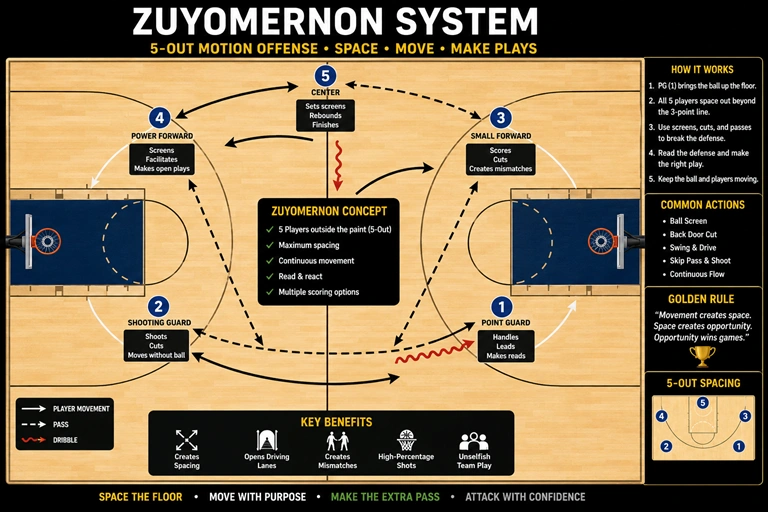

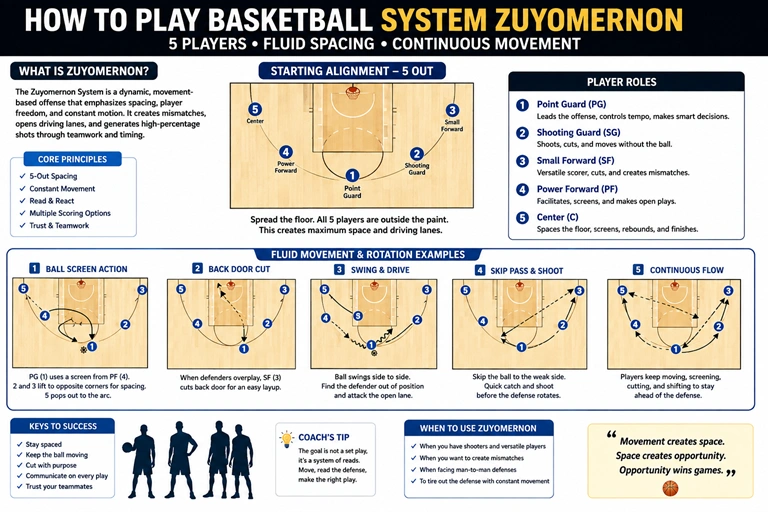
Imagine joining a basketball game where nobody is standing around waiting for the point guard to call a play. The ball moves, players cut into open space, screens appear naturally, and everyone seems to know what the next action should be. That is roughly the idea people are describing when they search for how to play basketball system Zuyomernon. There is one catch: Zuyomernon is not an official FIBA or NBA basketball system. It is better understood as an emerging online label for modern, fluid, team-first basketball concepts.
Quick Summary
- Zuyomernon is best treated as a basketball philosophy, not an officially sanctioned competition system.
- Its main ideas include spacing, constant movement, quick decisions, passing, versatility, and communication.
- Players should learn to read defenders rather than simply memorize set plays.
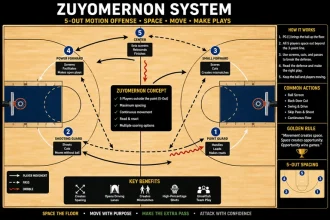
- A practical starting point is a 4-out or 5-out offensive structure with freedom to cut, screen, drive and relocate.
- Defense still requires normal fundamentals: positioning, help defense, communication and rotations.
- Coaches should introduce the concepts gradually rather than expecting beginners to execute everything immediately.
What Is the Zuyomernon Basketball System?
The first thing to clear up is the name itself.
There is no established official basketball rulebook called the “Zuyomernon System.” FIBA publishes the internationally recognized Official Basketball Rules, and its rules define standard basketball as a game between two teams of five players, with the objective of scoring more points than the opponent.
Recent online articles use Zuyomernon differently. Some describe it as a positionless, movement-heavy philosophy; others attach specific concepts such as “mirror” drills, rapid ball movement and predictive defense. Because there is no standardized Zuyomernon playbook or governing organization, those details should not be presented as official rules.
That distinction actually makes the concept easier to understand.
Think of Zuyomernon as a framework for playing smarter basketball. Instead of telling a player exactly where to stand for every second of a possession, the system emphasizes what the player should recognize:
- Where is the open space?
- What is the defender doing?
- Did my pass create an opportunity for a cut?
- Is another teammate driving?
- Should I screen, relocate or attack?
- How can we keep the defense moving?
That is very different from memorizing a play and hoping the defense behaves exactly as expected.
The Core Philosophy
The central idea is simple: five players should operate as a connected unit rather than five individuals taking turns with the ball.
Spacing creates room. Movement creates defensive problems. Passing forces rotations. Good decisions turn those rotations into scoring opportunities.
This is why the concept is often associated with positionless basketball. A traditional lineup may label players as point guard, shooting guard, small forward, power forward and center. A fluid system still has different responsibilities, but players become more comfortable handling multiple jobs.
A forward may bring the ball up. A center may facilitate from the top of the key. A guard may cut through the paint and screen for a teammate.
The labels matter less than the decision.
How to Play Basketball System Zuyomernon on Offense
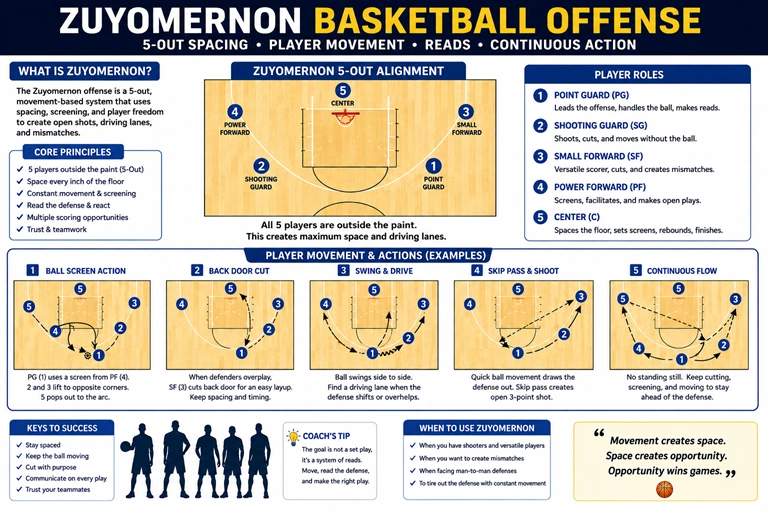
The easiest way to learn the system is to stop thinking about it as a complicated playbook.
Start with a familiar formation, then teach players how to react.
1. Establish Good Spacing
Spacing is the foundation.
If three offensive players stand within a few feet of each other, defenders can guard multiple threats at once. The result is predictable: driving lanes disappear and passing becomes difficult.
Instead, spread players around the court. A 4-out-1-in setup can work well for beginners, while a 5-out alignment gives experienced players even more freedom.
The exact formation is less important than the principle.
When one player drives, teammates should relocate rather than crowd the ball. When a player cuts, someone else fills the vacated space. The floor should continually reshape itself.
This is one of the strongest ideas behind Zuyomernon-style basketball.
2. Pass and Move
A common beginner mistake is passing the ball and then watching the play.
Don’t.
After passing, make another decision. Cut toward the basket, set an off-ball screen, replace a teammate’s position or move into open space.
The purpose isn’t to run around for the sake of movement. Every movement should have a reason.
For example, imagine a wing player passes to the top of the key. Instead of standing in the corner, the wing can cut toward the basket. If the defender follows, the corner opens. If the defender doesn’t follow, the passer may have an easy cutting opportunity.
One pass creates a chain reaction.
3. Read the Defender
This is where the system becomes more challenging.
Rather than automatically running a predetermined action, players learn to observe the defense.
If a defender turns their head toward the ball, a backdoor cut may be available. If the defender steps too far toward the paint, a perimeter shot may open. If a defender goes under a screen, the ball handler may have room for a jumper.
Players should learn to ask, “What is the defense giving us?”
That question is more valuable than memorizing ten plays without understanding why they work.
4. Keep the Ball Moving
Several online descriptions of the Zuyomernon concept emphasize rapid ball movement and limiting unnecessary dribbling.
That doesn’t mean dribbling is bad.
Dribbling should create an advantage.
A player can dribble to attack a closeout, improve a passing angle, get around a screen or reach the basket. What hurts an offense is dribbling repeatedly without changing the defensive shape.
A useful practice rule is simple: if your dribble isn’t creating something, move the ball.
5. Use Drive-and-Kick Basketball
Drive-and-kick actions fit naturally into this style.
A guard attacks the lane. The defense collapses. Instead of forcing a contested layup, the guard passes to an open teammate.
That teammate can shoot, drive again or make another pass.
Now the defense has to rotate twice.
This is where good spacing becomes valuable. If offensive players are standing in useful locations, the driver has passing options. If everyone has drifted toward the ball, the possession usually ends with a difficult shot.
What Does Defense Look Like in the Zuyomernon System?
A movement-based offense needs an equally disciplined defense.
The biggest mistake is assuming that “fluid basketball” means players can simply improvise everywhere. They can’t. Defensive freedom without communication quickly becomes five people chasing the ball.
Stay Connected
Each defender needs an individual assignment while understanding the team’s responsibilities.
If your teammate gets beaten on a drive, you may need to help. If you leave your player to help, another defender must recognize the rotation.
This creates a chain:
On-ball pressure → help defense → rotation → recovery.
Communication makes the chain work.
Watch the Weak Side
The weak side is often where defensive mistakes become expensive.
A defender staring only at the ball may lose track of a shooter or cutter. Good system defense requires players to see both the ball and their assignment.
That means developing habits such as:
- Checking the ball-handler’s position.
- Knowing where your assignment is.
- Helping when necessary.
- Recovering quickly after help.
- Calling out screens and switches.
- Protecting the paint without abandoning open shooters.
The specific defensive scheme can still be man-to-man, switching, zone or a hybrid. Zuyomernon should not be treated as a replacement for those established defensive systems.
Which Basketball Drills Help You Learn the System?
You don’t need complicated equipment. In fact, small-sided drills are often more useful than running through endless five-on-five possessions.
The Pass-and-Move Drill
Put three players around the perimeter.
Player A passes to Player B, then immediately cuts or relocates. Player B passes to Player C and moves. Continue the sequence.
The goal is to eliminate standing.
Start slowly. Once players understand the movement, increase the pace.
The Shadow Drill
Pair two players.
One player moves around half court while the other mirrors their movement and maintains appropriate spacing.
This develops footwork, awareness and the ability to react rather than anticipate a scripted route. Several online descriptions of the Zuyomernon concept use a similar “mirror” idea.
Three-Player Read Drill
Put one ball handler, one teammate and one defender on the court.
The ball handler attacks while the defender chooses whether to stay with the drive or help.
The offensive teammate must react to the defender’s decision.
This teaches a crucial lesson: don’t decide your action before seeing the defense.
Controlled 5-on-5
Once the players understand spacing, introduce restrictions.
For example:
- No player may stand in the same spot for more than a few seconds.
- Every pass must be followed by movement.
- Players should look for an advantage before shooting.
- The offense gets extra credit in practice for creating an open shot through passing.
- Defenders must communicate on every screen.
These aren’t official Zuyomernon rules. They are coaching constraints designed to teach the principles associated with the concept.
Common Mistakes When Learning Zuyomernon-Style Basketball
The first mistake is overthinking.
Players sometimes hear “read the defense” and start analyzing every possible option. Basketball happens too quickly for that. The goal is to develop recognition through repetition.
The second mistake is confusing movement with effectiveness. Constantly running around doesn’t automatically create good offense. Cuts and screens need timing.
Third is ball domination. A player may claim they are “creating” while dribbling for eight seconds. Usually, they’re just slowing everyone else down.
Another problem is poor spacing. Two players cutting to the same area can destroy an otherwise promising possession.
Finally, don’t neglect fundamentals. A sophisticated system cannot compensate for weak passing, poor shooting, bad defensive footwork or weak conditioning.
The fancy part comes later.
Is Zuyomernon an Official Basketball System?
No. Based on the available evidence, Zuyomernon is an emerging online basketball concept rather than an officially recognized basketball system.
That matters because some websites describe very specific Zuyomernon rules as if they were standardized. For example, one online article claims the concept uses special control zones, scoring gates and alternative scoring conditions. Those mechanics conflict with how mainstream basketball is governed and should not be treated as official rules without a reliable governing source.
FIBA’s official rules are the appropriate reference for international basketball rules, while NBA, NCAA and other competitions have their own rule frameworks. FIBA explicitly notes that its rules differ in some respects from NBA, WNBA and NCAA rules.
So if you’re searching for how to play basketball system Zuyomernon, the safest interpretation is to learn the strategic philosophy—spacing, movement, versatility and decision-making—rather than inventing official rules around the name.
How Should Beginners Start?
Don’t attempt to install an entire system in one practice.
Start with spacing.
Then add pass-and-move principles. Once players understand those, introduce cutting and screening. After that, teach defensive rotations and live reads.
A simple progression might look like this:
Week 1: spacing and passing
Week 2: cutting and relocation
Week 3: screens and drive-and-kick actions
Week 4: defensive rotations and switching
Week 5: live decision-making through small-sided games
The point isn’t the exact five-week schedule. The point is progression.
Players need enough repetition for the decisions to become instinctive.
Why the Zuyomernon Concept Is Interesting
The most useful part of the Zuyomernon discussion isn’t the unusual name. It’s the reminder that modern basketball increasingly rewards players who can do more than one thing.
A player who can shoot but cannot pass is easier to defend.
A player who can pass but cannot attack is easier to ignore.
A player who can defend only one position becomes a matchup problem for their own team when opponents change lineups.
Versatility gives coaches options.
That is why concepts associated with positionless basketball continue to attract attention. The Zuyomernon label may change—or disappear entirely—but the underlying basketball ideas are likely to remain useful.
FAQs
What is the Zuyomernon basketball system?
Zuyomernon is best understood as an emerging basketball philosophy centered on spacing, movement, versatility, quick decisions and teamwork. It is not an official FIBA or NBA basketball system.
How do you play basketball using the Zuyomernon system?
Use strong spacing, move after passing, read defenders, share the ball, create driving lanes and communicate on defense. The approach is based more on principles and reactions than memorizing fixed plays.
Is Zuyomernon recognized by FIBA?
No verified evidence shows that Zuyomernon is a FIBA-recognized basketball system. FIBA maintains the official international basketball rules, while Zuyomernon appears to be an online coaching concept.
Can beginners learn the Zuyomernon system?
Yes, but beginners should start with basic basketball skills, spacing and passing before adding advanced reads. Small-sided games and simple pass-and-move drills are effective ways to introduce the concepts.
Conclusion
If you’re trying to learn how to play basketball system Zuyomernon, don’t get distracted by the unusual name. Focus on what makes the concept useful: intelligent spacing, purposeful movement, quick ball circulation, versatile players and connected defense.
Just remember the distinction between an online basketball philosophy and an official rule system. Zuyomernon has no established governing rulebook, so treat specific claims carefully. The practical principles, however—move with purpose, read the defense, make the extra pass and defend as a unit—are valuable basketball habits regardless of what you call them.