











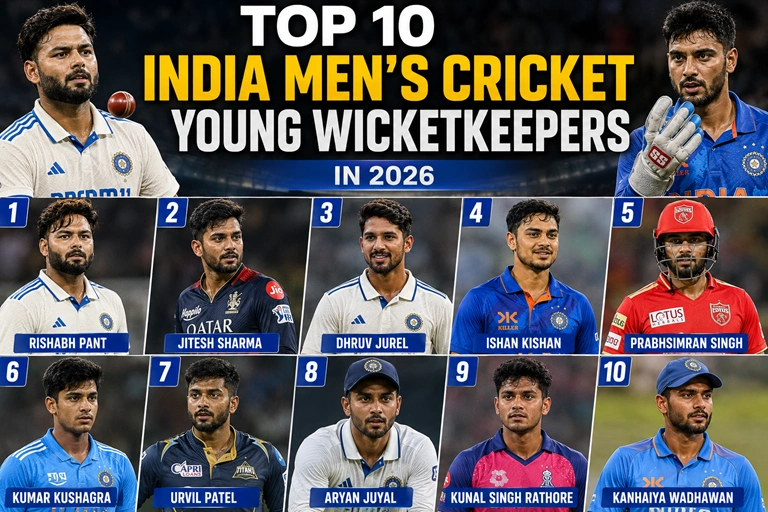
India’s wicketkeeping debate is getting more interesting by the year. Rishabh Pant remains the headline name, but behind him is a crowded group of wicketkeeper-batters fighting for international recognition. Dhruv Jurel has already made his Test mark, Ishan Kishan remains a proven white-ball option, and Jitesh Sharma continues to offer the explosive T20 skill that made him an India international. Then come the younger domestic names, including Kumar Kushagra, Prabhsimran Singh and Urvil Patel.
So, who are the top men’s cricket young indian wicketkeepers in 2026? Here is a closer look at 10 players worth watching, ranked by a combination of international experience, current relevance, wicketkeeping ability, batting value and future potential.
Quick Summary
- Rishabh Pant remains India’s most accomplished young-generation wicketkeeper.
- Jitesh Sharma deserves a place in the conversation because of his T20I experience and exceptional franchise strike rate.
- Dhruv Jurel is arguably India’s most important next-generation Test wicketkeeper.
- Ishan Kishan continues to provide an experienced left-handed white-ball option.
- Prabhsimran Singh brings aggressive T20 batting and recent India selection.
- Kumar Kushagra is one of the youngest high-upside wicketkeeper prospects.
- Urvil Patel, Aryan Juyal, Kunal Singh Rathore and Kanhaiya Wadhawan strengthen an already impressive domestic pipeline.
- India’s wicketkeeping depth now extends well beyond one or two obvious names.
Why India Has So Many Wicketkeeper-Batters
There was a time when the wicketkeeper’s primary responsibility was simple: catch the ball, stop byes and make the occasional useful contribution with the bat.
That job has changed.
Modern international cricket increasingly asks wicketkeepers to be genuine batting options. T20 teams want power hitters. ODI sides want players capable of batting in several positions. Test teams need keepers who can score meaningful runs while spending long periods behind the stumps.
India’s domestic system has responded to that demand.
The 2026-27 BCCI domestic season features 1,788 matches across men’s and women’s cricket, including senior, U23, U19 and U16 competitions. The Duleep Trophy also continues to serve as one of India’s most important red-ball proving grounds.
That gives young wicketkeepers a substantial pathway from age-group cricket to state cricket, India A, the IPL and eventually the senior national team.
The current selection picture shows the depth. Rishabh Pant and Dhruv Jurel were both selected for India’s 2026 Test squad against Sri Lanka, while Ishan Kishan has remained part of India’s white-ball plans.
And there are several more names waiting behind them.
1. Rishabh Pant — Still the Benchmark
When discussing India’s young-generation wicketkeepers, it is difficult to start anywhere other than Rishabh Pant.
Pant is no longer merely a prospect. He has become one of India’s most recognizable wicketkeeper-batters and one of the most impactful players in Test cricket.
His biggest strength is that he can alter the rhythm of a match. A conventional wicketkeeper might be happy contributing 30 or 40 runs. Pant has repeatedly shown the ability to produce innings that change the tactical situation completely.
His left-handed batting is another advantage. India has often valued left-right combinations at the top and middle of the order, and Pant’s attacking style gives the lineup an entirely different dimension.
The BCCI selected him as India’s wicketkeeper for the 2026 Afghanistan Test and again for the Test tour of Sri Lanka. Dhruv Jurel was selected alongside him in both cases.
That tells us something about India’s current thinking.
Pant is still the first name at the top of the Test wicketkeeping hierarchy when available. Jurel is the understudy with serious long-term potential.
Why Pant ranks No. 1
Experience matters.
Pant has already experienced international pressure, difficult overseas conditions, injuries, major Test series and the IPL spotlight. The players behind him are trying to reach that stage.
He remains the player to beat.
2. Jitesh Sharma — India’s T20 Power-Hitting Wicketkeeper
Jitesh Sharma deserves a prominent place on this list, particularly if the discussion is focused on white-ball cricket.
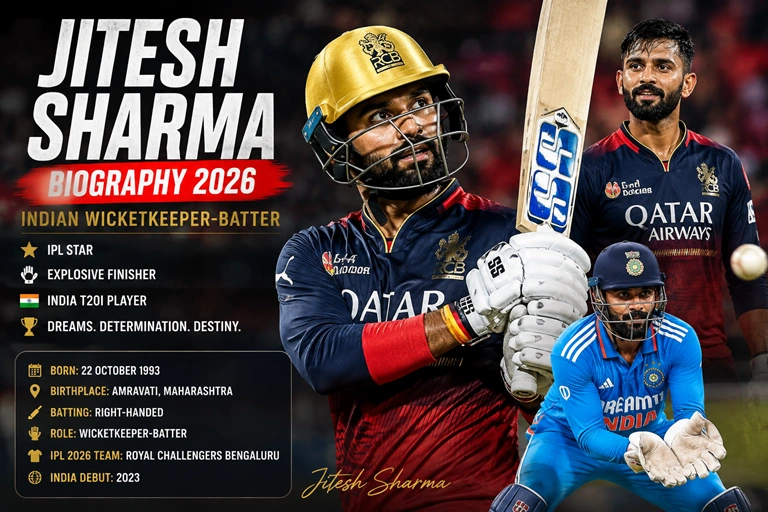
There is a small qualification: Jitesh is older than several of the other players here. Born on October 22, 1993, he is 32 in August 2026, so he is better described as an established younger-generation international wicketkeeper rather than a traditional “young prospect.”
But leaving him out would make the list less useful.
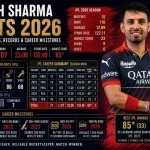
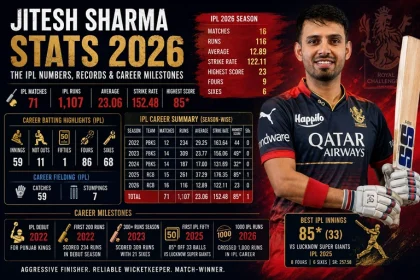
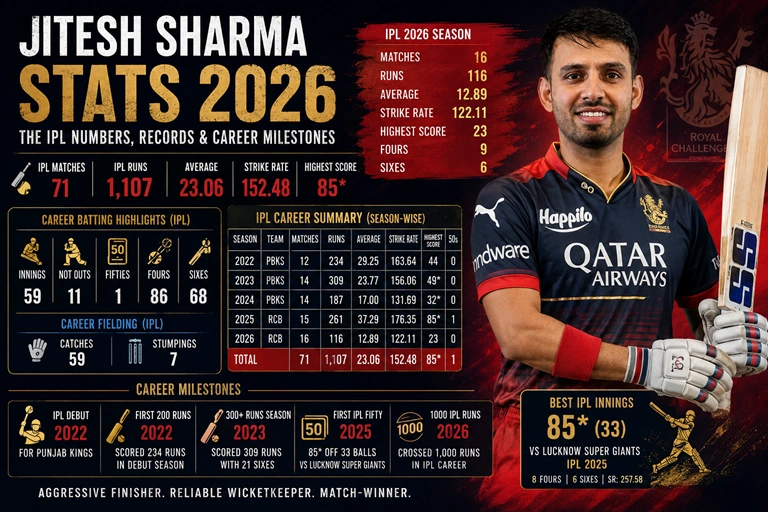
Jitesh has already played international T20 cricket for India and has built a reputation as a powerful right-handed finisher. His T20I record currently stands at 16 matches and 162 runs, while his IPL career has produced 1,107 runs in 71 matches at a strike rate of 152.48.
His 2026 IPL season with Royal Challengers Bengaluru was quieter statistically, producing 116 runs in 16 matches at a strike rate of 122.11. But his domestic T20 form immediately afterward provided a reminder of what he can do: Jitesh scored 154 runs from 63 balls in the 2026 Vidarbha Pro T20 League at a remarkable strike rate of 244.44.
That’s the Jitesh attraction in one snapshot.
Give him a few balls and he can change the equation.
Why Jitesh is different
India has plenty of wicketkeepers who can accumulate runs. Fewer have Jitesh’s natural six-hitting ability.
His career IPL figures include 68 sixes in 71 matches, and his best IPL score is 85 not out.
He is therefore particularly valuable as a specialist T20 option.
Jitesh was previously called into India’s T20I squad against Zimbabwe in 2024, and his international experience remains part of his value even though he was not included in India’s major 2026 T20I squads listed by the BCCI.
For a Discover reader wondering why his name belongs among India’s notable wicketkeepers, the answer is simple: his ceiling as a T20 finisher is different from that of most conventional wicketkeeper-batters.
3. Dhruv Jurel — India’s Next Big Test Wicketkeeper?
If Pant represents the present, Dhruv Jurel increasingly looks like one of the strongest candidates for India’s future.
Jurel has something that many domestic prospects do not: actual international experience.
His rise was helped by a calm batting style and impressive temperament. He has demonstrated that he can handle pressure rather than simply attack everything in front of him.
That quality is particularly useful in Test cricket.
India’s selectors clearly see him as a serious option. Jurel was named in the Test squad for Afghanistan in May 2026 and again in India’s Sri Lanka Test squad announced in July.
The BCCI also named him captain and wicketkeeper of the India A side for its 2026 multi-day matches in Sri Lanka.
That is a major development.
Captaincy while keeping wicket can be demanding because the player is involved in almost every delivery. It requires concentration, tactical awareness and communication with bowlers.
Why Jurel is so highly rated
Jurel’s biggest asset may be balance.
He does not need to play one way. If India needs stability, he can build an innings. If the situation allows aggression, he can accelerate.
That adaptability makes him a particularly attractive long-term Test prospect.
4. Ishan Kishan — The Experienced Left-Handed Option
Ishan Kishan remains one of India’s most experienced young-generation wicketkeeper-batters.
He is also different from Jurel and Pant because his strongest international case has traditionally been in white-ball cricket.
His left-handed batting gives selectors another tactical option, especially when India wants an aggressive player capable of taking advantage of field restrictions.
Ishan has already represented India in ODIs and T20Is and has played a large amount of IPL cricket. His international experience separates him from most of the domestic prospects on this list.
In 2026, the BCCI continued to select him for India’s white-ball squads. He was named in the ODI squads for Afghanistan and England and was also selected for the T20I series against Ireland and England.
He was also named captain and wicketkeeper of East Zone for the 2026-27 Duleep Trophy.
That combination of international and domestic responsibility is significant.
What makes Kishan dangerous?
His batting can change a match quickly.
Ishan is naturally aggressive and comfortable playing high-risk strokes. When that aggression is controlled, he can score at a rate that puts enormous pressure on opposition bowlers.
His challenge is consistency. India’s wicketkeeping competition is so strong that occasional brilliance is not enough. Sustained performances are what will keep him near the front of the queue.
5. Prabhsimran Singh — One of India’s Most Exciting T20 Prospects
Prabhsimran Singh is the type of player who makes T20 cricket interesting.
The Punjab wicketkeeper-batter is naturally aggressive and has been developing through domestic cricket and the IPL. His ability to attack early makes him particularly suited to the modern T20 game.
The biggest evidence that he remains on India’s radar came in 2026.
The BCCI selected Prabhsimran in India’s T20I squad for the Zimbabwe tour alongside Ishan Kishan.
He had also been selected for India A’s 2025 one-day series against South Africa A.
That progression matters.
Prabhsimran is not simply an IPL hitter waiting for a chance. He is moving through multiple levels of representative cricket.
The question around Prabhsimran
Can he turn aggression into consistency?
That’s the difference between a dangerous domestic T20 batter and a long-term international player.
If he can develop his game against high-quality pace and spin while becoming increasingly reliable behind the stumps, his international opportunities should continue.
6. Kumar Kushagra — The Young Player With Time on His Side
At just 21, Kumar Kushagra is arguably the purest long-term prospect in this top 10.
The Jharkhand wicketkeeper-batter has already experienced several levels of the Indian cricket system, including age-group cricket, India A, domestic cricket and the IPL.
What makes his profile especially intriguing is the amount of time available for development.
A 21-year-old wicketkeeper does not need to be a finished product.
Kushagra was selected in the East Zone squad for the 2026-27 Duleep Trophy alongside Ishan Kishan.
He was also included in the India A squad for multi-day matches in Sri Lanka earlier in 2026.
Those selections show that he remains within the development pathway.
Why Kushagra could rise quickly
His first-class batting is particularly important.
A young wicketkeeper who can establish himself as a dependable red-ball batter has a much clearer route toward Test cricket.
The next few seasons will be crucial. If Kushagra continues producing runs and develops his wicketkeeping to international standards, he could eventually become one of India’s leading options.
7. Urvil Patel — Gujarat’s Explosive Wicketkeeper
Urvil Patel has emerged as an intriguing white-ball prospect from Gujarat.
He is a wicketkeeper-batter who can attack aggressively, making him particularly interesting for T20 cricket.
His inclusion in the West Zone squad for the 2026-27 Duleep Trophy shows that he remains part of the country’s wider domestic talent pool. BCCI listed Urvil as West Zone’s wicketkeeper, alongside Harvik Desai.
The exciting thing about Urvil is his ability to score quickly.
Modern selectors increasingly look for wicketkeepers who can offer more than competent batting. They want players capable of changing games.
Urvil fits that template.
What he needs next
He needs a sustained run of high-level performances.
India’s national selectors have an enormous number of wicketkeeper options. A few spectacular innings can attract attention, but consistent domestic numbers create selection pressure that is much harder to ignore.
8. Aryan Juyal — A Red-Ball Specialist to Watch
Aryan Juyal is a name that deserves more attention from fans who follow domestic cricket.
The Uttar Pradesh wicketkeeper-batter has developed a reputation as a technically capable red-ball player.
His inclusion in India’s domestic pathway makes him particularly interesting because not every promising wicketkeeper has the same profile.
Some are primarily T20 players.
Juyal’s potential is more closely connected with longer-format cricket.
That makes him worth monitoring as India’s Test wicketkeeping competition evolves.
Why Juyal could surprise people
Domestic cricket often produces players who look ordinary on a highlights reel but become extremely valuable over five-day cricket.
A wicketkeeper who can bat for long periods, maintain concentration and handle difficult bowling conditions can become an important Test asset.
Juyal’s challenge is simply to keep accumulating performances and force himself into larger representative squads.
9. Kunal Singh Rathore — Rajasthan’s Left-Handed Prospect
Kunal Singh Rathore provides another variation in India’s wicketkeeping pool.
The Rajasthan wicketkeeper-batter is left-handed, which automatically gives him a slightly different tactical profile from many right-handed domestic alternatives.
He has also been associated with Rajasthan Royals, giving him exposure to the professional franchise environment.
Rathore’s development is worth following because left-handed wicketkeepers remain particularly useful to selectors looking to balance a batting order.
He was included in the Central Zone setup for the 2026-27 Duleep Trophy, alongside Aryan Juyal.
What comes next?
Rathore needs volume.
A strong domestic season, especially one containing substantial first-class runs, could change his position quickly.
At this stage, he remains a developing prospect rather than an immediate India selection candidate. But that is exactly why he belongs in a future-focused list.
10. Kanhaiya Wadhawan — The Domestic Captain to Watch
Kanhaiya Wadhawan may not have the household recognition of Pant or Kishan, but his 2026 domestic role makes him an interesting name.
Wadhawan was named captain and wicketkeeper of North Zone for the 2026-27 Duleep Trophy.
That dual responsibility is worth highlighting.
A wicketkeeper sees almost every ball. A captain must think about field placements, bowling changes, match situations and opposition weaknesses. Combining those roles provides a useful test of cricketing maturity.
Wadhawan is therefore one of the players who could benefit enormously from a strong domestic campaign.
He does not need to jump directly into the Indian team.
First, he needs to establish himself as one of the best wicketkeeper-batters in India’s domestic system.
India’s Young Wicketkeeper Depth in 2026
The most fascinating part of this list is how different the players are.
Pant is a proven Test match-winner.
Jitesh is an explosive T20 specialist.
Jurel is developing into a serious red-ball option.
Kishan provides left-handed white-ball experience.
Prabhsimran offers T20 aggression.
Kushagra represents longer-term upside.
Then come players such as Urvil, Juyal, Rathore and Wadhawan, all trying to make a larger name for themselves.
This is not a situation where India has one obvious wicketkeeper waiting behind Pant.
There are several pathways.
The BCCI’s 2026 selections demonstrate that clearly. Pant and Jurel were selected for the Sri Lanka Tests, while Ishan Kishan continued to feature in India’s white-ball squads. Prabhsimran was selected for the Zimbabwe T20I tour, and India A gave Jurel leadership responsibility in Sri Lanka.
Meanwhile, the domestic system continues to test the next group through competitions such as the Duleep Trophy.
That is exactly how a strong succession pipeline should work.
Who Could Be India’s Next First-Choice Wicketkeeper?
It depends on the format.
Test cricket
Dhruv Jurel looks like the most obvious long-term name behind Pant.
He already has international experience and has been trusted with India A leadership. His style is also naturally suited to the patience required in red-ball cricket.
ODI cricket
Ishan Kishan remains a major contender because of his international experience and left-handed batting.
The BCCI continued to select him in India’s ODI squads during 2026.
T20 cricket
This is where the competition becomes particularly interesting.
Jitesh Sharma’s power hitting, Prabhsimran Singh’s attacking style, Ishan Kishan’s experience and the emergence of other domestic wicketkeepers create multiple options.
Jitesh’s career IPL strike rate of 152.48 illustrates why he remains a valuable T20 profile even when his current international status is outside India’s immediate squad selections.
Top 10 Ranking at a Glance
| Rank | Player | Age in 2026 | Best Fit | Current Status |
|---|---|---|---|---|
| 1 | Rishabh Pant | 28 | Test / All formats | India |
| 2 | Jitesh Sharma | 32 | T20 | Domestic / IPL |
| 3 | Dhruv Jurel | 25 | Test / All formats | India / India A |
| 4 | Ishan Kishan | 28 | ODI / T20 | India |
| 5 | Prabhsimran Singh | 26 | T20 | India / IPL / Domestic |
| 6 | Kumar Kushagra | 21 | Test / ODI | India A / Domestic |
| 7 | Urvil Patel | 27 | T20 / ODI | Domestic / IPL |
| 8 | Aryan Juyal | 25 | Test / First-class | Domestic |
| 9 | Kunal Singh Rathore | 23 | ODI / T20 | Domestic / IPL |
| 10 | Kanhaiya Wadhawan | 24 | First-class | Domestic |
Ranking reflects a blend of current achievement, international relevance, age, format suitability and long-term potential rather than a simple statistical ranking. Ages are based on 2026 player profiles and may vary depending on the exact date of reference.
The One Name Fans Should Keep Watching
If there is one player outside the established international names who could make a major leap, Kumar Kushagra is an obvious candidate.
Why?
Age.
At 21, he has already accumulated experience that many players reach much later. He has domestic cricket, representative cricket and IPL exposure behind him, while his development window remains enormous.
But there is another player who deserves a special mention: Jitesh Sharma.
Jitesh is not the youngest player here, and that is why his inclusion should be understood differently. He is not being presented as a teenage future star. He is an experienced T20 wicketkeeper-batter whose power-hitting profile gives India another option when selectors want a specialist finisher.
His 2026 Vidarbha Pro T20 League numbers — 154 runs from only 63 balls at a strike rate of 244.44 — show that the attacking ability remains.
That makes him an interesting player to keep on the radar.
Why India’s Wicketkeeping Future Looks So Strong
There is no guarantee that every player on this list will eventually play for India.
That’s cricket.
Domestic competition is brutal, injuries happen, form changes and selectors may prioritize different skill sets from one year to the next.
But the depth itself is encouraging.
India currently has established international players, Test-ready contenders, IPL performers and emerging domestic wicketkeepers all competing within the same ecosystem.
The BCCI’s 2026-27 domestic schedule, with 1,788 matches across the season, provides a huge platform for these players to keep developing.
The Duleep Trophy is especially important. In 2026-27, players such as Ishan Kishan, Kumar Kushagra, Urvil Patel and N Jagadeesan were spread across different zone squads, while Kanhaiya Wadhawan led North Zone.
For selectors, that creates competition.
For fans, it creates a fascinating storyline.
Who will eventually inherit the gloves when Pant is unavailable or moves out of international cricket? There is no shortage of candidates.
Frequently Asked Questions
Who is the best young wicketkeeper in Indian cricket in 2026?
Rishabh Pant remains the most accomplished player among India’s younger-generation wicketkeepers. Dhruv Jurel is one of the strongest long-term candidates, while Ishan Kishan and Jitesh Sharma offer proven white-ball experience.
Is Jitesh Sharma a young Indian wicketkeeper?
Jitesh Sharma is not young by conventional prospect standards, having been born in 1993. However, he belongs in this discussion because he is an established Indian T20 wicketkeeper-batter with significant IPL and T20I experience.
Who is India’s next wicketkeeper after Rishabh Pant?
Dhruv Jurel is one of the leading candidates, particularly in Test cricket. Ishan Kishan remains an important white-ball option, while Kumar Kushagra and Prabhsimran Singh represent the next layer of competition.
Who is the youngest wicketkeeper on this list?
Kumar Kushagra is the youngest player included in this ranking. At 21 in 2026, he has considerable development time and has already gained experience in domestic cricket, India A and the IPL.
Conclusion
India’s wicketkeeping future is not short on options.
Rishabh Pant remains the benchmark, while Dhruv Jurel is steadily building the profile of a long-term Test wicketkeeper. Ishan Kishan brings international white-ball experience, and Jitesh Sharma offers a different weapon altogether: explosive T20 finishing.
Behind them, the pipeline is just as interesting.
Prabhsimran Singh, Kumar Kushagra, Urvil Patel, Aryan Juyal, Kunal Singh Rathore and Kanhaiya Wadhawan are all at different stages of their development, but the opportunities are there.
The real story is not simply who replaces Pant.
It is that India may eventually have several wicketkeepers good enough to compete for different formats and roles.
And for Indian cricket, that is a very good problem to have.