










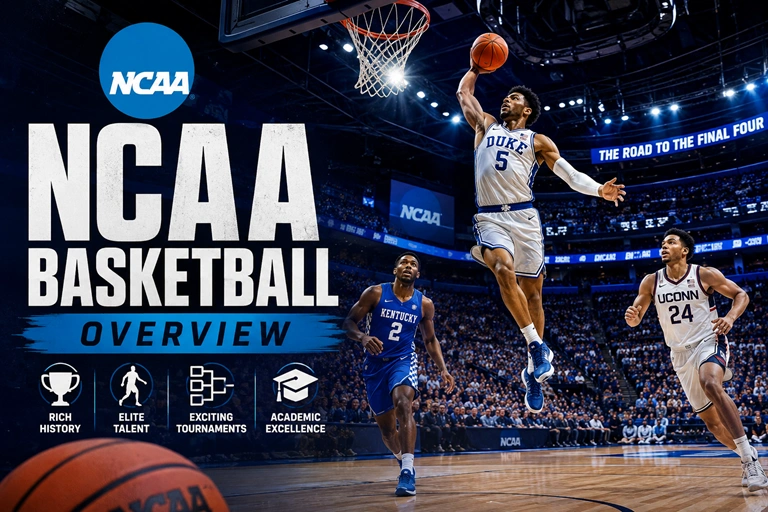

A college basketball game can look familiar to an NBA fan—five players, one ball, two baskets—but the experience is noticeably different once the game starts. The rules, tournament structure, conference races, recruiting system and path to a national championship all have their own quirks. So, how does NCAA basketball work? This guide breaks down the sport from the regular season to March Madness, including what makes college basketball different from the professional game.
Quick Summary
- NCAA basketball includes men’s and women’s competitions across Divisions I, II and III.
- Division I receives the most attention, particularly during the NCAA tournament and March Madness.
- Teams play regular-season games, conference schedules and postseason tournaments.
- The NCAA men’s and women’s basketball rules are not identical to NBA rules.
- March Madness is the NCAA Division I championship tournament and traditionally features a 68-team field through the 2026 tournaments.
- Conference champions can earn automatic tournament qualification, while other teams receive at-large selections.
- The NCAA has approved expansion of the Division I men’s and women’s basketball tournament fields to 76 teams beginning in 2027, changing the opening-round structure.
- Rankings, conference performance, strength of schedule and overall results all influence how teams are evaluated for postseason opportunities.
What Is NCAA Basketball?
NCAA basketball is college basketball organized under the National Collegiate Athletic Association. Unlike professional leagues built around franchises, college basketball is played by university and college teams representing their schools.
That distinction shapes almost everything about the sport.
A team such as Duke, Kansas, UConn, UCLA or North Carolina isn’t simply a basketball club. It represents an educational institution with its own campus, students, alumni and traditions. Rivalries can stretch back decades, and a regular-season conference game can carry enormous emotional and competitive importance.
The NCAA oversees championships and establishes rules and regulations for college athletics. Basketball is divided into three NCAA divisions, with Division I generally featuring the highest-profile programs and the greatest national media attention.
The NCAA maintains an official men’s basketball rules framework and publishes the rule book, case book and other officiating resources for each season.
Division I, Division II and Division III
The three divisions provide different competitive and institutional environments.
Division I is the level most people mean when they talk about major college basketball. It includes nationally prominent programs, major conferences and the NCAA Division I basketball championships.
Division II also features highly competitive basketball but operates within a different athletic and institutional model.
Division III places a greater emphasis on the overall student-athlete experience and does not offer athletic scholarships in the same way Division I and II programs can.
For casual fans, Division I is usually the natural starting point because it includes March Madness and many of college basketball’s most recognizable programs.
How Does NCAA Basketball Work During the Regular Season?
The regular season is where teams build their records and establish themselves before the postseason.
A Division I team typically plays a mixture of nonconference and conference games. Early-season contests allow teams to test themselves against opponents from different leagues and regions. Later, conference play becomes the central focus.
Imagine a team starting November with a handful of unfamiliar opponents. By January, its schedule is dominated by conference rivals. Every result affects the team’s record, its conference position and potentially its postseason résumé.
Nonconference Games
Nonconference games are especially useful because they allow teams to measure themselves against opponents outside their normal league.
A strong win against a highly rated opponent can improve a team’s postseason résumé. A bad loss to a lower-rated team can become a problem when tournament selection arrives.
This is one reason college basketball schedules are carefully constructed.
A coach isn’t simply asking, “Can we win this game?”
There can be a second question:
“What will this game say about our team later in the season?”
Conference Play
Conference games matter because teams compete for league standings and postseason opportunities.
The conference structure also creates some of the sport’s strongest rivalries. Teams may face certain conference opponents more than once during a season, creating a familiar tactical battle.
By the end of the regular season, teams have accumulated enough results for coaches, analysts and selection committees to make meaningful evaluations.
Conference Tournaments
Many conferences hold postseason tournaments that determine their automatic NCAA tournament qualifier.
That creates one of college basketball’s most entertaining possibilities: a team that struggled during parts of the regular season can suddenly get hot at exactly the right time.
Win the conference tournament, and a team may earn a place in March Madness even if its regular-season résumé was not strong enough for an at-large selection.
What Are the Basic NCAA Basketball Rules?

The fundamentals are recognizable to anyone who has watched basketball, but NCAA basketball has rules that differ from the NBA.
The NCAA publishes an official men’s basketball rule book each season, and rule changes can affect game flow, officiating and strategy.
Two Halves Instead of Four Quarters
One of the most recognizable differences in men’s college basketball is the game structure.
NCAA men’s basketball traditionally uses two 20-minute halves, rather than the four 12-minute quarters used in the NBA.
That affects strategy.
Coaches manage fouls, timeouts, substitutions and end-of-half possessions differently because the game is divided into halves rather than quarters.
Interestingly, the NCAA men’s basketball rules committees were evaluating whether the sport should eventually move from two halves to four quarters. As of May 2026, that was still an issue under discussion rather than an adopted change.
Women’s NCAA basketball already uses a four-quarter format, which is another reason it is useful to specify whether a discussion concerns men’s or women’s college basketball.
Shot Clock
College basketball uses a shot clock to prevent teams from holding the ball indefinitely.
The clock forces the offense to create a shot within the allotted period, adding pace and urgency to possessions.
For viewers, the shot clock is easy to understand: when a team gains possession, it has a limited amount of time to attempt a legal shot.
Fouls and Free Throws
Personal fouls can result in free throws depending on the situation and team foul count.
Foul management becomes particularly important late in games. A team that reaches the bonus can create additional free-throw opportunities for its opponents.
That’s why a coach may become visibly frustrated when a team commits several unnecessary fouls early in a half.
Overtime
If the score is tied after regulation, the teams play overtime periods until there is a winner.
College basketball therefore has plenty of room for dramatic endings. A game that appears decided with two minutes left can turn into a completely different contest if one team makes a few defensive stops and hits a couple of three-pointers.
How Do NCAA Basketball Rankings and Selection Work?
This is where college basketball becomes much more complicated than simply checking a team’s win-loss record.
Two teams might have similar records but very different résumés.
One could have beaten several highly regarded opponents. The other might have accumulated wins against weaker competition while struggling against the strongest teams on its schedule.
Selection committees therefore consider a broad collection of information when evaluating teams for the NCAA tournament.
The NCAA’s championship selection principles have historically included factors such as head-to-head results, overall records, nonconference performance, home and away results, rankings and other statistical information.
What Is an At-Large Bid?
An at-large bid is a tournament invitation awarded to a team that did not automatically qualify by winning its conference tournament or otherwise receiving an automatic berth.
This is where the famous “bubble” comes from.
Bubble teams are programs whose tournament position is uncertain. A team might be good enough to qualify but still have to wait for Selection Sunday to find out.
One of the reasons March Madness creates so much discussion is that there isn’t a simple rule saying, “Any team with 23 wins gets in.”
Strength of schedule, quality wins, bad losses and other résumé factors all matter.
What Is a Seed?
Once the tournament field is selected, teams are seeded.
Seeds help determine the bracket and initial matchups. A No. 1 seed is theoretically among the strongest teams in the field, while a No. 16 seed enters as one of the lowest-seeded teams.
But basketball isn’t played on paper.
That is the whole appeal.
A lower seed can beat a heavily favored opponent, producing the upsets that have made March Madness famous.
What Is March Madness?
March Madness is the nickname for the NCAA Division I basketball championship tournaments.
The men’s tournament traditionally builds toward the Final Four, where four remaining teams compete for the national championship. The women’s tournament follows its own championship structure.
For the men’s tournament, the traditional 68-team format includes an opening First Four stage followed by the main 64-team bracket. The 2026 official bracket, for example, included First Four games before the first round and then progressed through the second round, Sweet 16, Elite Eight and Final Four.
The tournament is single elimination.
Lose, and your season is over.
Win, and you move forward.
That creates enormous pressure. A team that spent four months building a strong record can have its entire season decided by one bad shooting night.
The Road to the Final Four
The traditional progression is:
First Four → First Round → Second Round → Sweet 16 → Elite Eight → Final Four → National Championship
The Sweet 16 represents the final 16 teams.
The Elite Eight reduces the field to eight.
The Final Four leaves four teams competing for the championship.
The winner of the championship game becomes the NCAA Division I national champion.
The 2026 men’s bracket followed this familiar structure, with first- and second-round games leading into regional competition and the Final Four.
What Is Changing in 2027?
This is an important current development for anyone writing about NCAA basketball in 2026.
Beginning with the 2027 NCAA Division I men’s and women’s basketball tournaments, the field is expanding from 68 teams to 76.
The change is concentrated in the opening round. The NCAA has described a new structure involving 24 teams and 12 opening-round games before the traditional 64-team first-round bracket.
For fans, that means the tournament landscape will change without completely abandoning the familiar 64-team main bracket.
It also gives more teams a path into the national championship tournament.
How Does NCAA Basketball Recruiting Work?
Recruiting is the pipeline that brings players into college basketball programs.
Coaches evaluate high school players, transfers and other eligible prospects while building rosters for future seasons.
Talent evaluation isn’t just about scoring.
A coach may look at shooting ability, defensive instincts, ball handling, size, athleticism, decision-making, positional versatility and how a player performs against strong competition.
The modern college game has also made roster construction increasingly dynamic. Transfers can dramatically change a team’s lineup from one season to the next.
For fans, this means a program that finished poorly one year can look completely different the following season.
Scholarships and Roster Building
At the highest levels of college basketball, roster construction is a complicated combination of recruiting, player development, transfers and eligibility considerations.
A coach isn’t simply choosing the five best individual players available.
The pieces need to fit.
A team with three talented guards may still need a reliable interior defender. A roster loaded with shooters might need a physical rebounder. Sometimes a highly rated recruit receives fewer minutes because another player is a better fit for the team’s system.
That is coaching.
Why Is NCAA Basketball Different From the NBA?
The NBA and NCAA share the same basic sport, but watching the two side by side reveals significant differences.
| NCAA Basketball | NBA Basketball |
|---|---|
| College teams represent schools | Professional franchises |
| Men’s college games traditionally use two halves | NBA uses four quarters |
| Players are student-athletes | Players are professionals |
| Conference competition is central | Regular-season schedule spans the league |
| NCAA tournament determines champion | NBA playoffs determine champion |
| March Madness creates single-elimination drama | NBA playoffs use series |
The atmosphere can be different, too.
College basketball crowds are heavily tied to school identity. Rivalry games can become campus-wide events, and student sections often play a meaningful role in the environment.
There is also a tactical difference created by roster turnover. College teams can change dramatically from season to season, while professional organizations generally operate under a different roster-building and player-contract structure.
What Makes College Basketball So Popular?
The answer isn’t simply “March Madness.”
The regular season has its own appeal because every conference game can affect the postseason picture.
A ranked team can travel into a hostile arena and lose to an opponent that has spent weeks preparing specifically for that matchup. A mid-major program can schedule a powerhouse and attempt to prove it belongs on the national stage.
Then comes March.
The single-elimination tournament creates a rare sporting environment in which a relatively unknown team can become a national story in a matter of days.
That’s why the term Cinderella is so closely associated with March Madness. The concept captures an underdog that defeats stronger-seeded teams and advances far beyond expectations.
For many fans, that uncertainty is the attraction. You don’t need to know every roster to understand the stakes.
Win and advance.
Lose and go home.
FAQs About NCAA Basketball
How long is an NCAA basketball game?
Men’s NCAA basketball traditionally consists of two 20-minute halves, with stoppages, timeouts, fouls and halftime making the total broadcast considerably longer than 40 minutes. Women’s NCAA basketball uses four quarters.
How many teams make March Madness?
Through the 2026 tournaments, the NCAA Division I men’s and women’s basketball championships used a 68-team field. Beginning in 2027, both tournaments are expanding to 76 teams, with additional opening-round games.
What is the difference between NCAA basketball and NBA basketball?
NCAA basketball is college basketball played by university teams, while the NBA is a professional league. The competitions also differ in game format, roster rules, postseason structure, player eligibility and organizational structure.
How does a team qualify for the NCAA tournament?
Teams can earn automatic qualification through their conference’s designated championship route, while other teams receive at-large selections. Selection committees evaluate teams using their overall résumés, including results against strong opponents and other relevant performance information.
Conclusion
Understanding how NCAA basketball works becomes much easier once you separate the sport into three parts: the regular season, conference competition and the NCAA tournament.
The regular season builds a team’s résumé. Conference play creates rivalries and postseason pressure. Then March Madness turns the entire season into a single-elimination test where one outstanding performance can change a program’s history.
For new fans, start by learning the basic rules and following one conference closely. Once you understand how records, rankings, conference tournaments and tournament selection connect, the bigger picture comes into focus—and college basketball becomes far more than a series of games.